Most sellers assume the dock is like the deck or the driveway. It's attached to the property, it shows up in listing photos, and it transfers to the new owner the same day everything else does. On Lake Murray, that assumption is wrong, and it tends to surface at the worst possible moment: during a buyer's attorney review, a week or two before closing.
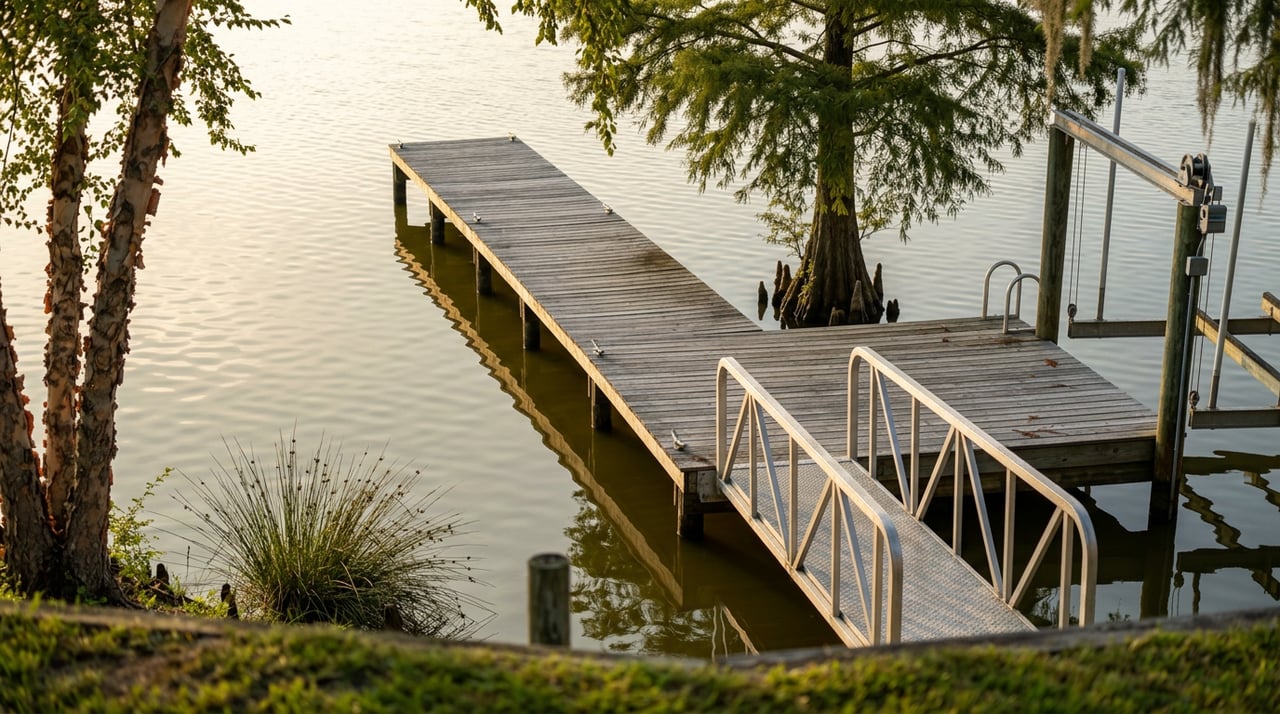
The dock sitting at the end of your yard is not a deeded fixture. It's a permitted structure on a federally licensed hydroelectric reservoir, and the permit that authorizes it does not move with the sale unless someone actively makes that happen.
Why Lake Murray Plays by Different Rules
Most residential waterfronts answer to a county building department and maybe a homeowners association. Lake Murray answers to Dominion Energy first, because the lake exists as part of the Saluda Hydroelectric Project, operated under a federal license. Dominion's Lake Management team is the primary authority for docks, piers, boat lifts, retaining walls, and anything else built below the water's edge. The U.S. Army Corps of Engineers also holds jurisdiction because Lake Murray is a navigable public waterway, which is part of why shoreline rules here read more like federal compliance documents than local zoning code.
The number you'll hear lake residents and agents throw around is "the 360." That's the 360-foot contour elevation, the reference line Dominion uses to mark normal maximum pool and, along much of the shoreline, the property boundary between Dominion-owned land and private upland lots. Anything below that line, including your dock, sits on land Dominion controls, not land you own outright.
Two Approvals, Two Timelines
If your home sits in an HOA community, you likely assume your dock was approved once and you're done. In practice, Dominion Energy approval and HOA or architectural review approval run on entirely separate tracks. One governs compliance with the federal license. The other governs compliance with your community's private covenants. Passing one review says nothing about the other, and a homeowner who secured HOA sign-off while skipping Dominion's process, or the reverse, is still out of compliance on whichever track they skipped.
For a seller, this matters because a buyer's due diligence period is exactly when these gaps get found. A dock that "everyone knows is fine" because it's been there for twenty years can still lack a matching Dominion permit on file.
What Actually Forces a New Permit
Homeowners tend to think of the original dock permit as a one-time event. It isn't. Certain changes require an updated filing with Dominion, and most owners don't realize it until a sale is underway:
- Adding a boat lift
- Extending the dock, even by a few feet
- Adding a jet ski platform or swim ladder
- Enclosing a previously open slip
Each of these is a modification to a structure Dominion already reviewed once, and each one technically needs its own approval. Many owners make the change, assume nobody will notice, and move on. Then a buyer's attorney or inspector compares the physical dock to what's on file with Dominion, finds a mismatch, and the discrepancy becomes a negotiation point instead of a footnote.
When the Paperwork Doesn't Exist
Older homes carry a related problem: the permit may simply be hard to find. Dominion has digitized a large share of its historical dock records, but permits from decades ago sometimes require real research to track down, especially if the home has changed hands more than once since the dock was built. If a seller can't produce the permit and Dominion's own records come up incomplete, a buyer may reasonably ask for a new survey or inspection to confirm the dock is actually compliant, which adds both time and cost to a transaction that was otherwise ready to close.
Where the Boundary Actually Sits
Dock permits specify exact location relative to property lines and shoreline, not just general placement. Dominion requires a minimum lot width of 100 feet along the 360-foot contour before it will consider an individual residential dock application, and 200 feet for a shared slip dock. Narrower lots, between 50 and 100 feet, platted before 1989 with neighboring docks already in place, may qualify for a limited-size dock, but that's a case-by-case determination, not a guarantee.
When a dock or lift extends beyond its permitted footprint or edges into a neighbor's permitted area, it stops being a maintenance question and becomes a boundary dispute, exactly the kind of issue a buyer's attorney wants resolved before closing rather than after.
What South Carolina Requires You to Disclose
South Carolina law requires sellers to complete a Residential Property Condition Disclosure Statement, and the existence, condition, and permit status of a dock count as material facts under that requirement. A seller who knows a dock was modified without an updated Dominion permit, or who knows the permit can't currently be located, is disclosing a known condition, not volunteering extra paperwork. Getting ahead of this before a buyer's attorney raises it tends to produce a smoother negotiation than getting caught flat-footed by it.
A Pre-Listing Checklist for Lake Murray Sellers
Before your home goes on the market, it's worth working through this list rather than discovering gaps during due diligence:
- Locate your current Dominion Energy dock permit and confirm the permit number matches what's physically installed.
- Compare the dock's actual footprint, lift count, and any platforms or enclosures against what the permit describes.
- If you've made any changes since the original approval, contact Dominion's Lake Management office to confirm whether an updated permit is needed.
- Separately confirm your HOA or architectural review approval is on file, since it won't substitute for Dominion's sign-off or vice versa.
- Pull your plat and recent survey so the 360-foot contour and property lines are documented before a buyer asks.
- Note any dock condition issues, structural wear, loose flotation, debris, that could read as a maintenance violation under the permit terms.
Every floating dock on Lake Murray has also been required to have encapsulated flotation since January 1, 2007. If your dock predates that rule and hasn't been updated, that's worth confirming before it comes up as an inspection finding.
The Lake Itself Is Part of the Timing
Lake Murray's water level moves with the season, and that has practical consequences for anyone timing dock repairs or a listing. As of early July 2026, Dominion's own gauge had the lake sitting at roughly 357.2 to 357.5 feet, just under its typical summer target of around 358 feet, according to reporting from the Post and Courier. A few tenths of a foot doesn't sound like much, but it changes what's visible below a dock and how a boat lift performs, which is one more reason sellers benefit from inspecting dock hardware now rather than waiting until a buyer's inspector does it for them.
The 2026 recreation season adds its own set of dates worth knowing if you're marketing a lakefront home this summer. Dominion's public beach and recreation area on the Lexington side is open April 1 through Labor Day, September 7, 2026, with day passes reserved online and cash no longer accepted at the gate. The Irmo-side boat launch made the same switch to online-only payment this year. Separately, Dominion has been running a multi-year restoration of the dam's intake towers, work that's continued through 2026 but is confined to a work zone near the dam itself and hasn't changed lake levels.
None of this replaces a conversation with Dominion's Lake Management office at 803-217-9221, but it's the kind of context that shapes when repairs are practical and how a buyer might read the current state of the lake during a showing.
FAQ
Does a dock permit automatically transfer when I sell my Lake Murray home? No. The permit doesn't move with the deed automatically. A buyer who skips the reassignment process can end up responsible for a structure Dominion no longer considers properly permitted under the new ownership.
What if I added a boat lift years ago and never updated the permit? That's worth resolving before you list. It's a common gap, and it's exactly the kind of mismatch a buyer's inspector or attorney tends to catch during due diligence.
Do I need both HOA approval and Dominion approval, or just one? Both, and they're independent of each other. Neither approval satisfies the other, so a dock can be fully compliant on one track and out of compliance on the other.
What counts as a material fact I have to disclose about my dock? Known issues with the dock's condition, its permit status, and any unpermitted modifications are the kinds of facts South Carolina's disclosure form is built to capture.
If you're weighing a sale on Lake Murray and want to know what your specific dock situation looks like before a buyer's attorney tells you, Hannah Norman has walked Midlands sellers through exactly this kind of due diligence. Let's connect and get your free home valuation, dock paperwork and all.